


Product Overview
-
The NEW GEMORO ASSAY LAB is a portable desktop XRF Energy Dispersive Spectrometer precious metal analyzer, that is proudly made in the USA. It features a premium SDD detector, which is the most advanced and accurate type available. The compact, sleek, ergonomic design fits comfortably on a desk or counter and has a bright touchscreen, full color display.
The GEMORO ASSAY LAB is the perfect solution for analyzing precious metals and it’s ideal for jewelers, pawn shops, jewelry manufacturers, appraisers and precious metal scrap buyers.
Users can benefit from this fast and efficient, safe, non-destructive technology that produces surface test results that are comparable to a fire assay without destroying the jewelry. Quickly identify and measure each element in jewelry, coins, watches, and more.
-
- Super-fast, non-destructive & precise
- Intuitive interface
- Autonomous & PC operation
- Advanced plating detection
- Measures 24 different elements
- Compact, sleek & ergonomic design comfortably fits on a desk, bench or counter
- Full view leaded glass window
- Large 7” touchscreen full color display
- Fully portable battery or AC powered
- Built-in handle for transporting
- Proudly designed and made in USA
STANDARD FEATURES
- Superior SDD detector
- Rechargeable twin Li-ion 6+ hour battery
- Built-in Wi-Fi, Bluetooth and GPS
- Fully shielded lid with safety interlock protection
- Collimators
- Fully Cloud-enabled
- Two CCD cameras
- Imbedded computer.
X-ray Fluorescence or XRF is a non-destructive, analytical method used to determine elemental concentrations of various materials on the surface of what is being analyzed. It’s important to recognize that not all XRF analyzers have the same capabilities.
SPECIFICATIONS Testing Area 3mm Diameter Measuring Depth Up to 10-20 microns Tube Life Expectancy 8,000 Hours or 2.8M ~10 Second Tests Tube Specification 40K V, 200uA Rh Anode , 1 Beam Detector Rate 7 mm2 SDD, silicon drift detector, (active area), 170 eV resolution FWHM at 5.95 Mn K-alpha line Camera Built-in, high-resolution camera for sample viewing and a macro-camera for photo-documentation or 2D/3D barcode reading and storage Battery Life Includes AC Adapter, Battery Charger and 1 Rechargeable Battery – 6 Hour Battery Life Computer Data Transfer WIFI, Bluetooth, USB Connectivity to Most Devices Calibration Check Manually Applied 316 Stainless Steel Shutter – Included – is used for calibration when turning the device on and whenever the user desires without having to physically send their device to GEMORO to be recalibrated Environmental Temp. Range 10°F to 130°F at 25% Duty Cycle Security Password Protected Usage (user level) and Internal Settings (admin) Warranty 3-Year WarrantyXRF Spectrometry Data Method
XRF Spectrometry can use either Empirical Methods (calibration curves using standards similar in property to the unknown) or Fundamental Parameters (FP) to arrive at quantitative elemental analysis. The GEMORO XRF ASSAY LAB Gold & Precious Metal Analyzer uses the superior Fundamental Parameters because it allows elemental analysis to be performed without standards or calibration curves, which is much more preferred. This enables the analyst to use the system immediately, without having to spend additional time setting up individual calibration curves for the various elements and materials of interest. FP, accompanied by stored libraries of known materials, determines not only the elemental composition of an unknown material quickly and easily, but can identify unknown materials as well.
More on How XRF works:
XRF works by striking a sample with an X-ray beam from an X-ray tube, causing characteristic X-rays to fluoresce from each element in the sample. A detector measures the energy and intensity (number of X-rays per second at a specific energy) of each X-ray, which is transformed into an elemental concentration using either a non-standard technique such as fundamental parameters or user-generated calibration curves. The presence of an element is identified by the element’s characteristic X-ray emission wavelength or energy. The amount of an element present is quantified by measuring the intensity of that element’s characteristic X-ray emission.
The Atomic Level
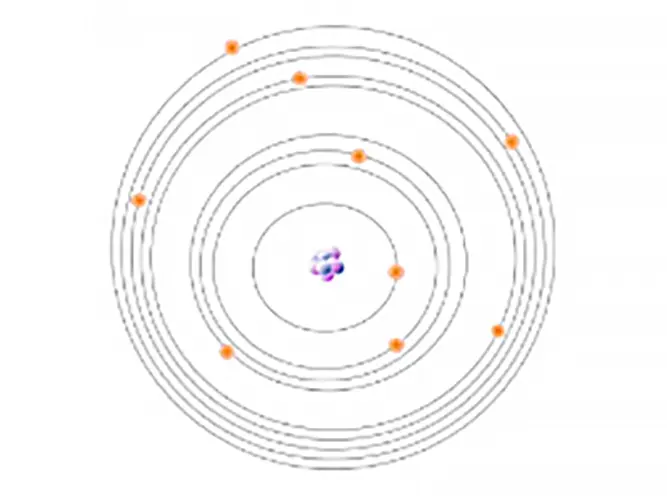
All atoms have a mixed number of electrons. These electrons are arranged in orbitals around the nucleus. Energy Dispersive XRF (EDXRF) typically captures activity in the first three electron orbitals, the K, L, and M lines.
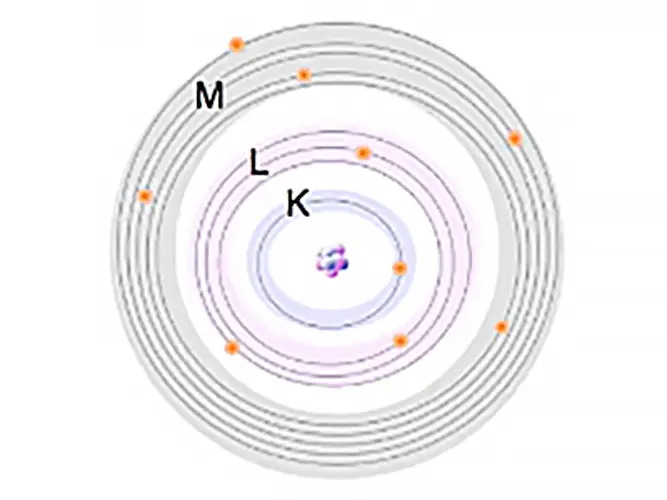
These electrons are arranged in orbitals around the nucleus. Energy Dispersive XRF (EDXRF) typically captures activity in the first three electron orbitals, the K, L, and M lines.
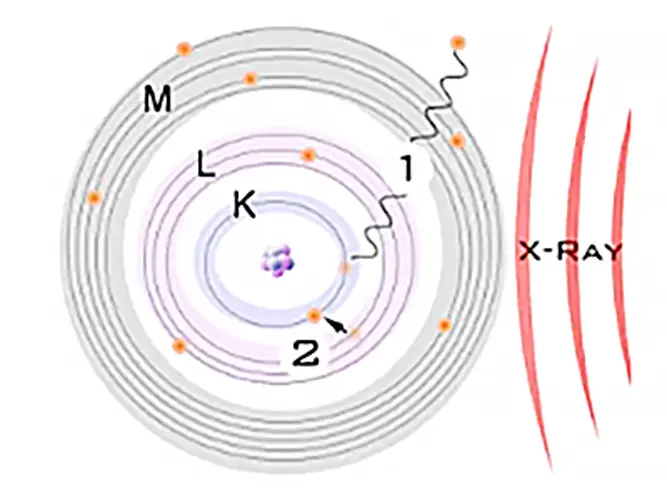
The primary photons from the X-ray tube have high enough energy that they knock electrons out of the innermost orbitals, creating a vacancy (1). An electron from an outer orbital will move into the newly vacant space at the inner orbital to regain stability within the atom (2).
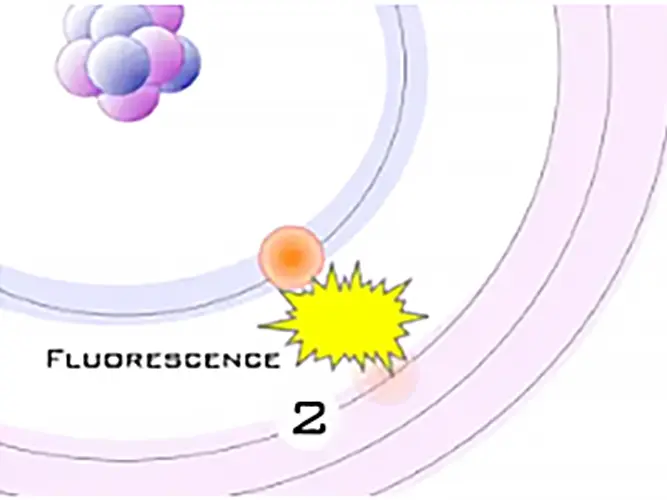
As the electron from the outer orbital moves into the inner orbital, it releases energy in the form of a secondary X-ray photon. This energy release is known as fluorescence. All elements produce fluorescence “characteristic” to themselves. Each element’s fluorescence is unique to itself.
X-RAY
Sample Material
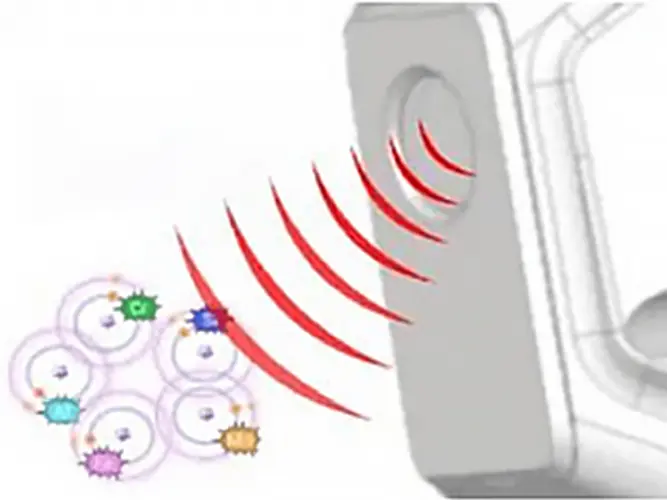
High-energy primary X-ray photons are emitted from an X-ray tube and strike the sample.
DETECTOR
Sample Material
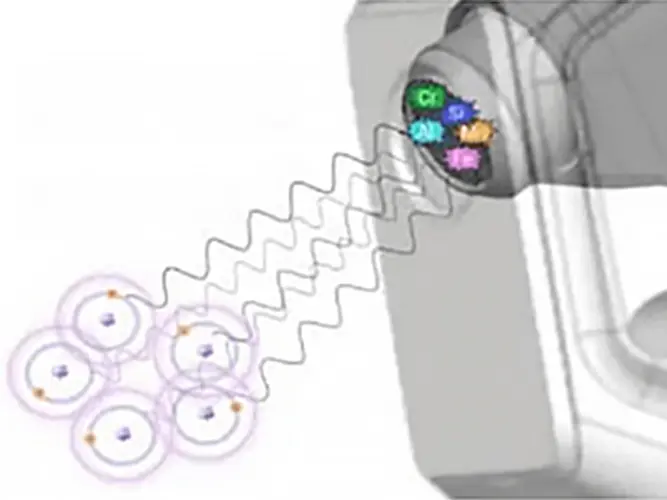
The fluorescent energy is transferred to a detector, where it is absorbed and transferred into an electrical signal and then into a number (digitized).


